A Personal (and slightly irreverent) Jazz Glossary
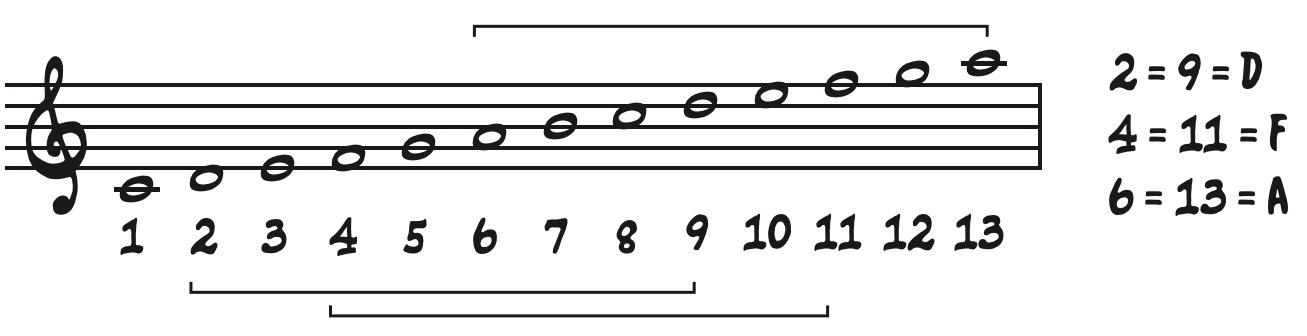
2 vs 9: see Rule of 7.
2 chord (C2): A triad containing 1 – 2 – 5. Sometimes calles a sus 2. Very open sounding, not really major or minor (no pesky 3 to worry about!)
iiø V i progression (minor keys): Same idea as ii V I in major keys, EXCEPT: the ii chord is half diminished/mi7(b5), the V chord often has a b9, #9, or #5, and the i is of course minor. (Ex: Dø or Dmi7(b5) – G7(b9) – Cmi.) TIP: the C harmonic minor scales sounds great over the iiø V (the Dø or Dmi7(b5) – G7(b9). I’m not a fan of the harmonic minor over the i chord personally, but’s that’s just me.
3-7-3 rule: When the roots of a chord progression follow the descending circle of 5ths, the 3rd of the first chord connects smoothly to the 7 of the next, which connects smoothly to the 3rd of the next, and so on. It’s easier to grasp if you look at the example below (it’s the first 8 bars of the jazz standard “All The Things You Are.”). By “smoothly” I mean not changing at all (that’s very smooth!) or moving down by a half- or whole step. Many jazz players refer to this as a guide tone line.
4 vs 11: see Rule of 7
5 chord (C5): A 2 note “chord” including the 1 and 5 (no 3!) Octave doubling is allowed. You’ve heard these a million times…ask your guitar player friends to show you “power chords!” Not to be confused with the V chord from theory!
6 vs 13: see Rule of 7
ii V I progression (major keys): Probably the most common chord progression in jazz. The numbers refer to a mi7 chord built on the ii, a dominant chord built on the V, and a major chord built on the I (Ex: in C major, Dmi7 G7 CMa7.) Jazz improvisers MUST master these in all 12 keys. Note that the roots (D – G – C) forllow the circle of descending 5ths. The “lite” version (ii V) is even more common.
6/9 chord (Major): The 6/9 chord is a major triad with both a 6 and 9 added. The “Ma” part of the symbol is not always included. Ex: C 6/9 = C E G A D. Note the quartal structure when this is revoiced as E A D G C (a very nice voicing for this chord!) This is a nice chord to use when the melody in the tonic, as there is no major 7 chord tone to clash with it.
8va: Play this section one octave higher. (Best to use a dotted line to indicate how long to play 8va. The term “loco” mean to play in the written octave.)
8vb: Play this section one octave lower. (Best to use a dotted line to indicate how long to play 8vb. The term “loco” mean to play in the written octave.)
9th chords: In general, a 5 note chord that contains the 1 – 3 – 5 – 7 – 9. Any of these chord tones, except of course the root,. can be altered as needed to create the type on 9th chord desired.
11th chords: In general, a chord that uses the 1-3 – 5 – 7 – 9 – 11. However, this doesn’t really sound very good (try it.) Remember, the 11 of a chord is the same “letter” as the 4 of the scale (see “Rule of 7”.) Usually, if there is an 11 in the chord (same note as 4) it really clashes with the 3. Practical rule: avoid having a major 3rd and an 11. For higher extensions like the 11 and 13, you can assume that the lower extensions can be included. So, C11 (a dominant chord) would include C G Bb D F (the 3rd, E, is omitted.) Cmi11 would include C Eb G Bb D F (no conflict with the Eb, as it’s the lowered 3rd.) Major 11 chords are not common, but CMa7 (#11), which includes C E G B D F#, sounds great (no 3/11 conflict!)
13th chord: In general, a chord that uses the 1-3 – 5 – 7 – 9 – 11 – 13. However, this doen’t sound very good (try it.) Remember, the 11 of a chord is the same “letter” as the 4 oth the scale (see “Rule of 7”.) Usually, if there is an 11 in the chord (same note as 4) it really clashes with the 3. And, for higher extensions like the 11 and 13, you can assume that the lower extensions can be included. So, C13 (a dominant chord) would include C E G Bb D A (the 11, F, is omitted.) Cmi13 would include C Eb G Bb D F A (no conflict with the Eb, as it’s the lowered 3rd.) Major 13 chords also omit the 11. A #11 does sound nice, but in that case it’s best to add the #11 to the chord symbol (Ex. CMa13(#11). You might want to check out Super arpeggios, below.
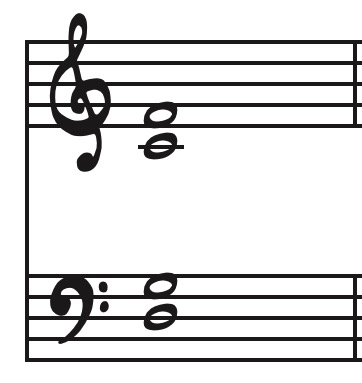
Add 9 (or 2): A chord containing 1 – 2 – 3 – 5 (or 1 – 3 – 5 – 9) Not the same as the “2” chord, which has no 3 (this one does.) I’m a big fan of add9 chords with the 3rd in the bass, like this.
Aeolian: The 6th mode of the major scale, also called the natural minor. To create a C aeolian from C major, lower the 3, 6, and 7. Often used as the basic scale sound for tunes in minor keys. See “A New View of the Modes” in Jazz Theory 101 for more.
Alteration: A note in the scale that is raised [#9, +9, aug.9] or lowered [b9, -9] by a half step. Ex: C7(b9 #5) My preference is to use flat/sharp signs–short, and no room for confusion.
Altered dominant (alt) chord: A dominant chord that includes the absolutely necessary 1 – 3 – b7, plus any of these alterations: b9, #9, b5, #5. Beware of enharmonic imposters! ☠️ And yes, the enharmonic name DOES matter…it’s a b5, not a #11. This pairs perfectly with the altered dominant scale (below.)
Altered dominant scale: A great scale for dominant chords in which every possible alteration occurs: b9, #9, b5, #5. There cannot be a natural 9, 11, or 13. Sometimes referred to as the super locrian or diminished/whole tone scale (not by me though.) It’s also the 7th mode of the ascending melodic minor (jazz minor) scale. This pairs perfectly with the altered dominant chord (above.)
Altered pentatonic: A pentatonic scale that has at least 1 note raised or lowered. Ex: C major pentatonic = C D E G A. One example of an altered pentatonic would be the Cminor/major = C D Eb G A. These are very cool sounding scales…a mixture of the familiar and the new. There’s some good info in these in Jazz Theory 301.
Arpeggio: The notes of a given chord, played one at a time (melodically outlining the chord.)An essential part of your practice routine…right?
Augmented (chord): “Augmented” [+, aug.] refers to the raised 5. A C+ triad = C E G#. When used in a dominant chord, it’s assumed that it’s the 5th that is raised. Ex: C+7 = C E G# Bb.
Augmented (interval): A major or perfect interval with the top note raised by a half step OR the bottom note lowered by a half step. Your university there prod is going to be strict on enharmonics, so beware. C – G# is an augmented 5th; C – Ab is a mi6, even though they sound the same.
Back door (dominant): Usually the I of the key is “set up” by its V. But, it also sounds great when the I is set up by the dominant chord based on the bVII (Ex: Bb7 – CMa7.) It sounds even better when we make that Bb7 part of a ii V (Ex: Fmi7 Bb7 CMa7.) Some look at this as iv – bVII – I, but to me it makes more sense as a “backdoor ii V.” Check out “Just Friends” or “Stella By Starlight” for some real-life examples. And, check out my friend Anton Schwartz’s site for great info in the backdoor dominant.
“Better” Blues Scale: A blues scale that I encourage developing improvisers to learn. The scale tones are 1 2 b3 5 6 8. The advantages when playing blues: sounds hipper, less beginner-y, it’s way funkier, and there are fewer “ouch” notes over the IV chord. You can also think of this as a “minor-major” pentatonic (minor 3, major 6.) I think maybe I invented the name Better Blues Scale, but I wouldn’t bet on it. 🙂
Bird Blues: A 12 bar blues with the usual structural elements in place (I chord in m. 1, IV chord in m. 5, turnaround in m. 9) BUT with a lot more chords added. These extra chords may include secondary dominants or ii Vs, tritone substitutions, and more. Charlie Parker’s Blues for Alice is one well-known example. Check out Blues for Jazz Musicians in Jazz Theory 201.
Block voicing: Block (or close) voicings group the chord tones as close together as possible (stacked up, they resembles blocks.) For 4 note chords this means the span of notes, bottom to top, is always less than an octave. Block voicings can also be inversions of the chord. This is an essential part of the voicing vocabulary for arrangers and for comping instruments.
Blue note: In practical usage, a lowered 3, 7, or sometimes 5, where one might expect a major interval. An essential part of the jazz DNA. Also, an important jazz record label, and the name of several jazz clubs.
Blues (progression): Short definition: a 12 bar form, often AAB, with roots in the musical traditions of the Mississippio Delta. At its simplest, blues can use just the I, IV, and V chords, while “Bird” blues changes can be extremely complex. The “constants” are usually: I chord in m. 1; IV chord in m. 5; and a turnaround at the end of the form.Please see the info on blues on the Jazz Theory 101, 201, and 301 pages for more detailed info.
Blues scale: A scale that includes all of the “blue” notes, but no 2 or 6. Ex: C blues scale = C Eb F F#* GF Bb C. Can be considered as a minor pentatonic with a chromatic passing note between the 4 and 5. [Note: *I teach this as a raised 4 when the line goes up, and a lowered 5 when it goes down.] This is go-to sound for new improvisers, but I find it to be waaaaay overused. Educators, please encourage youre students to push beyond this one sounds for their improvising. ) Good news…there is a “Better Blues Scale!” Check it out in Jazz Theory 101.
Borrowed chords: A chord borrowed from the parallel minor or major key (the one that starts on the same tonic.) Ex: In the progression CMa7 Fmi7 CMa7; the Fmi7 is the “borrowed” iv chord of C minor. This is not the same as “borrowed cords”, which is what bass players do at every rehearsal. 🙂 Just kidding—it’s every other rehearsal.
Chord progression: Simply put, a series of chords. In jazz, a sequence of chords that is a) commonly used (Ex: ii V I], b) is often the basis for other tunes [Ex: rhythm changes, blues], and that c) hopefullysounds good. Great improvisers have internalized many common chord progressions, and are “fluent” in all keys. This should be everyone’s goal.
Chord substitution: Replacing the given chord(s) with a different chord (or set of chords) to create harmonic interest or tension. Ex (bridge of rhythm changes in Bb): instead of D7 G7 C7 F7 BbMa7, try D7 Db7 C7 B7 BbMa7. Here, Db7 and B7 are the tritone substitutions for G7 and F7. I’ll be adding more detailed info and examples on this in Jazz Theory 201 and 301.
Chord tone: A note that part of the given chord symbol (Ex: the chord tones of Dmi7 are D – F – A – C.) Often suggested to new improvisers as a way to outline the harmony (or “nail the changes.”)
Chord/scale relationship: The idea that every chord implies a scale (sometimes more than one) that sounds great over that chord because the chord tones are included in the scale. Every scale also implies several chords that are derived from that scale. Knowing these relationships is essential for jazz improvisers.
Chorus: One time through the form of the tune (ex: playing 12 bars of the blues, or 32 bars of an AABA standard etc.) For guuitarists, an outboard effect that creates that swirling, airy sound.
Chromatic: Movement by half steps.
Chromatic approach chord: The name is a pretty good definition, actually. You can approach a target chord chromatically from above or below. This sounds especially cool with blues changes.
Chromatic scale: A scale consisting entirely of half steps.
Circle of…: A circle that includes all 12 chromatic notes, arranged in intervals of 4ths, 5ths, etc. This is often presented as the Circle of 5ths, and moves clockwise from C G D A etc. My preferred way of teaching the Circle is the Circle of Descending 5th (moving clockwise from C F Bb Eb etc.) Why? Because this is the way music moves! The V to I progression is the strongest…and C is the V of F, F is the V of Bb and so on. Do NOT call this the circle of 4ths. Trust me on this one. If you don’t trust me on this one, check out my lesson on the Circle of (Descending) Fifths here. Personal note: I learned it the C G D A way first too. Then I learned how music actually works, and I changed my approach. To change is to grow. 🙂
Cluster: A chord voicing that uses small intervals (minor or major seconds) to create interesting harmonic textures. Used carefully, it’s a beautiful texture.
Coltrane changes ( harmony): The short version: a harmonic progression that establishes brief new tonal centers that are a major 3rd apart. These can be “set up” with their V chord, or with a ii V. This is one of those definitions where seeing is way better than reading, so check out this example. The classic example is Coltrane’s Giant Steps, but check out the bridge of Have You Met Miss Jones too.
Comping: The art of creatively accompanying a soloist by providing chords that support and outline the harmony, inspire the soloist, and keep the groove going, without ever getting in the way. “Comp” is short for accompany, compliment, and compose. I have lots of additional info in the Rhythm Section 101 link.
Contrafact: Did you know that you can only copyright the melody and lyrics to a song, but not the title or the chords? True. So it you were a jazz musician back in the day, and you recorded “What Is This Thing Called Love” because you love soloing on those changes, the royalties for recording the song went to whoever wrote it. But…if you wrote your own melody, AND gave it a new title (you’d still be soloing over the same chords anyway), well, that’s way better for you. More $$. And so contrafacts were born. There are a LOT of them (all those rhythm chanmges tunes!) including Donna Lee, In Walked Bud, Hot House…best get Googling! (Oh…and what jazz tunbe is a contrafact of “What Is This Thing Called Love”?)
Diatonic: A melody or chord progression that stays withing the confines of a specific key (so no accidentals!) To be diatonic in the key of F means no B naturals or C#s are allowed.
Diminished 7 chord: A 4 note seventh chord containing the 1 – b3 – b5 – bb7. In the jazz-o-verse, it’s common to treat the bb7 as 6, to avoid double flats. The chord symbol is usually C°7 (preferred) or Cdim7. In jazz, C° and C°7 are considered interchangeable. Fun fact #1: diminished 7 chords are built entirely of minor 3rds, and any of those 4 notes can function as the root. So, there are really only 3 dimished 7 chords! (3 chords x 4 notes = 12 tones.) Fun fact #2: Dim. 7 chords are closely related to dom7 (b9) chords. Spell out C7(b9), then E°7. See? 🙂
Diminished (chord): A triad containing the 1 – b3 – b5. Ex: C° (preferred) or Cdim. It’s not ucommon to interpret C° as a diminished seventh chord (see above.)
Diminished (interval): A minor or perfect interval with the top note lowered by a half step OR the bottom note raised by a half step.
Diminished scale: A symmetrical scale built from a series of whole- and half steps. In its whole-half step form, it’s used for diminished chords.See the Diminished/Dominant 9 Scale page in Jazz Theory 301 for more details. [Note: I refer to the half- whole step version of this as the Dominant 9 Tone scale; agaain, see Jazz Theory 301 for more.) Many theory professots refer to this as an octatonic scale. That’s totally fine. 🙂
Diminished whole tone scale: Please. See altered dominant scale.
Dominant 7 chord: A seventh chord with a major 3 and a lowered 7. In Western music, the only diatonic dominant 7 chord is built on the V of the scale, and the tendency is for that V to resolve to I. In chord symbols, just use the 7. Ex: C dominant seventh chord is written as C7. Fun fact: Any chord symbol that’s an odd numer higher than 7 is always part of the dominant chord family/ Ex: C9, C11, C13 are all dominant.
Dominant 9 tone: A symmetrical scale built from a series of half- and whole steps. You could say it’s a “mode” of the diminished scale. The chord implied is dominant 7 with a b9, #9, #11, or 13. This is an amazingly cool and useful scale that you should master. And, because it’s from the “diminhed” world, there are really only 3 “keys” to worry about. See the Dimished/Dominant 9 Tone Scale page in Jazz Theory 301 for more details.
Drop 2 voicing: A block voicing with the 2nd note from the top dropped down an octave. Here’s an example.
Drop 3 voicing: A block voicing with the 3rd note from the top dropped down an octave. Here’s an example.
Enclosure: A cool melodic technoque that uses the note above and the note below the “target” melody note (often this is a chord tone.) The two enclosure notes can be diatonic (within the key) or chromatic, or a combination.
Extension: The “higher than 7” odd numbers of the extended scale or chord. Ex: the 9, 11, or 13.
First inversion: Take a root position chord (1 – 3 – 5 – 7) and move the bottom note up an octave (now, 3 – 5 – 7 – 1). First inversions have the 3rd on the bottom.
Functional harmony: A way of looking at the role (or function) of chords as being tonic, dominant, or sub-dominant. This approach works well for most jazz standards, while more contemporary tunes often use non-functional approaches.
Guide tones: A melodic “skeleton” based on chord tones, designed to help the soloist define the harmony more clearly. The strongets guide tones are the 3 and 7 of the chord (lowered as needed, of course), as they help define the quality of the chord (major? minor?) The 5 is an OK choice too. The root lacks color…not my first choice for a guide tone line. Tip: check out how guides tones relate to the 3-7-3 rule!
Half step: The smallest interval in Western music; E – F or B – C on a piano (adjacent white notes); F – F# or A – Bb (black note next to white note on piano.) Adjacent frets for fretted instruments. These occur naturally in the major scale between the 3 – 4 and 7 – 8 scale tones. Considered a strong dissonance.
Half-diminished 7 chord: A 4 note seventh chord containing the 1 – b3 – b5 – b7. Cø is the common chord symbol; adding the 7 after the ø is not necessary. This is the vii chord in major keys, but is most common;y used as the ii chord in minor keys. It is often written as Cmi7(b5). I prefer this because it’s very descriptive (and less likely to be misread as a diminished chord), but ø is a lot shorter. You’ll see both in the real world, so get used to it. My advice for composers/arrangers: pick one and stick with it.
Half-whole diminished scale: See Dominant 9 Tone scale.
Harmonic minor: One of the must-know minor scales. It’s the natural minor (Aeolian) scale with a natural 7. EX: C harmonic minor = C D Eb F G Ab B C. This is also the same as the C major scale with a lowered 3 and 6. Its unique sound comes from the minor 3rd interval between the b6 and 7. Yje 5th mode of harmonic minor is very useful over the minor ii V progression in bebop.
Hemiola: A type of polythythm; in jazz, a way of creating rhythmic tension by introducing a feeling of “3 against 2” (try tapping quarter notes and singing a series of dotted quarter nores.)
Hexatonic: Having 6 notes, like the whole tone scale.
Interval: The distance between 2 notes, expressed as a number (2nd, 3rd etc.) and a quality (major, minor, perfect etc.) Reminder: count the lower note as “1”! Fun fact: when you convert intervals, 2 cool things happen. First, the interval and its inversion always add up tp 9. Ex: 3rds invert to 6ths, 5th invert to 4ths. Second, major intervals invert to minor, perfect remains perfect, and diminished inverts to augmented (and vice versa is all cases, going any direction.) We had a substitute band teacher in 8th grade, and he showed us this. I was the only one who cared, I think. 🙂
Inversion (chord): The result of moving the bottom note of a chord to the top. The result is the same set of chord tones, but a) in a different register and b) with a different top (melody) note. Both of these are important to comping instruments and to the composer/arranger.
Ionian mode: This is the mode built on the first degree on the major scale…in other words, the major scale. The difference is that “C major” implies a definite key, with all the harmonic (and as a result, melodic) implications. “C Ionian” is less bound to specific harmony, and so is less restrictive melodically.
Jazz minor: The ascending version of the melodic minor scale, using the same notes when descending (unlike the actual melodic minor.) Many jazz musicians refer to this as the jazz minor scale, to avoid confusion with the melodic minor. You can also get there by taking a major scale and lowering only the 3rd. Ex: C jazz minor = C D Eb F G A B C. It sounds great over minor chords with a 6, maj7, or 9. See more on this great scale in Jazz Theory 201. BTW, the modes of the jazz minor are really REALLY cool, and I highly recommend that you dig deep into them.
Key of the moment: See tonal center.
Leap: A melodic interval larger than a 3rd.
Locrian mode: The 7th mode of the major scale. To create a C locrian from C major, lower the 2, 3, 5, 6, and 7. Ex: C locrian = C Db Eb F Gb Ab Bb C. Usually used over the ii half-diminished chord in minor keys, although I think the Locrian ♮ 9 is much cooler. See “A New View of the Modes” in Jazz Theory 101 for more.
Locrian ♮ 9 scale: THIS is the sound I love for the ii half-diminished chord in minor keys! The name says it all: locrian but with an “unlowered” 2 (or 9…same note.) So, Locrian ♮ 9 = C D Eb F Gb Ab Bb C. You can also think of it as the 6th mode of jazz minor. I think the ♮ 9 sounds a lot better that the b9. Try it! More info in Jazz Theory 201 for the committed musicians out there.
Locrian raised (#) 9 scale: Another term for Locrian ♮ 9. I guess to unlower something also means to raise it. Still…
Lydian mode: The 4th mode of the major scale. Lydian is a major mode, as it has both a major 3 and 7. Its unique sound is a result of its raised 4th degree. I use it a lot for non-tonic major chords, or any time I want to create the ethereal unresolved quality of the lydian’s most important note, the #4. To create a C lydian from C major, just # that 4: C D E F# G A B C. See “A New View of the Modes” in Jazz Theory 101 for more.
Lydian augmented scale: A lydian scale that also has a #5. I use this for Ma7(#5) chords. These are not all that common, but I love the sound, and try to sneak them in whenerer I can (like when the melody is the 3 or 7 of a major 7 chord…sweet!). This is the 3rd mode of the jazz minor scale.
Lydian dominant scale: As the name implies, there’s a #4 (lydian) and a b7 (dominant) in this scale, which is the 4th mode of the jazz minor. Ex: C Lydian Dominant = C D E F# G A Bb C. The extension of the dominant chord that are included in the scale are 9, #11, and 13. This is an important part of the jazz vocabulary, so get busy and learn these! Find out more on the Jazz Theory 201 page.
Major (chord): A chord that has a major 3rd and (if there is a 7 present) a major 7. The I and IV chords in major keys are major chords.In chord symbols, sually, major is assumed, and minor or dominant chords need to be indicated. So, for a C major triad, just write C (not Cmaj.) Some writers use a triangle to indicate major (I don’t, personally.)
Major (interval): Major intervals include Ma2, Ma3, Ma6, and Ma7. These reflect the distance from the tonic (1) of a major scale to the 2, 3, 6, or 7.
Major 7 chord: A seventh chord with a major 3 and a major 7 Ex: CMa7 = C E G B. The I and IV chords are major 7 chord in major keys. Ma7 is the preferred chord symbol. Maj7 is overkill, and M7 might be misread as m7. I’ve seen C7 used for major 7 chords, but I think this is a terrible idea, as many folks write 7 as 7. Still others use a triangle for major 7, and others use a triangle for ANY major chord. Too much room for confusion, I say! Let’s agree that Ma7 is the shortest and least confusing chord symbol. You are welcome. 🙂
Major pentatonic: When most people say “pentatonic,”, they are referring to the major pentatonic (except guitar players, who often use “pentatonic” to mean the minor version.) I use the full term “major pentatonic” when I want to avoid any confusion. This is a 5 note scale, using the 1 2 3 5 6 of the major scale. You can learn more (including some cool substitutions!) on the Jazz Theory 201 and Jazz Theory 201 pages.
Melodic minor scale: This is one of the basic minor scales that all classically trained practice. It’s a natural minor scale with a raised 6 and 7 when ascending (Ex: C D Eb F G A B C), and a lowered 6 and 7 when descending (Ex. C Bb Ab G F Eb D C.) Jazz musicians often prefer te ascending form no matter which direction ti’s being played. To avoid confusion many jazz players (myself included) call this “same both directions” version the jazz minor scale.
Minor (chord): A chord that always has a lowered 3rd. If there is a 7, assume it’s also lowered (Ex: Cmi7 = C Eb G Bb.) If a major 7 is needed, the chord symbol will show this. Ex: Cmi(Ma7).
Minor (interval): A major interval with its top note lowered by one half step OR with its lower note raised by one half step. Ex: F – Ab = mi3; F# – A = mi3. Brain twister: F – Gb is a mi2, but F – F# is not. Why?
Minor 6/9 chord: A minor chord with both the 6 and 9 added. The “mi” part of the symbol is always included. Ex: Cmi 6/9 = C Eb G A D. Note the quartal (with one augmented 4th) structure when this is revoiced as Eb A D G C (a very nice voicing for this chord!)
Minor 7 ♭5 chord: A 4 note seventh chord containing the 1 – b3 – b5 – b7. It is often written as Cmi7(b5). This is the vii chord in major keys, but is most common;y used as the ii chord in minor keys. Another commonly used name is half-diminished (Ex: Cø).
Minor 7 chord: A four note chord that contains 1 – b3 – 5 – b7. Preferred chord symbols for this chord are Cmi7 orC -7. Cm7 is fairly common, but easy to misread as CM7.
Minor blues: A blues tune set in a minor key. Look for minor I and iv chords, and the use of minor ii V I progressions as well. Popular minor blues tunes include Mr. P.C., Equinox, Footsteps, and One For Daddy-O. Trivia question: Copltrane’s Eqionox was originally in what key?
Minor pentatonic: This is the minor version of a pentatonic, using 1 b3 4 5 b7 8. As you can see, it outlines the minor 7 chord. It also sounds a lot like the blues scale (minus the #4/b5.) Fun fact: just as there’s a relative major/minor relationship with keys, there’s also one for pentatonics. So, C major and A minor (relatives) share the same notes in their respectice pentatonics. Ex: C maj. pent. = C D E G A C; A min. pent. = A C D E G A. See? Same notes. You can learn more (including some cool substitutions!) on the Jazz Theory 201 and Jazz Theory 301 pages.
Minor-major pentatonic: The major pentatonic, except with a lowered 3 (that explains the hyphenated name!) The scale tones are 1 2 b3 5 6 8; in C, that’s C D Eb G A C. I also refer to this as the “Better Blues Scale.” Neither of these is a commonly used term, but I like them both, and hope they’ll catch on. You can learn more (including some cool substitutions!) on the Jazz Theory 201 and Jazz Theory 301 pages.
Mixolydian mode:The 5th mode of the major scale. Mixolydiaydian is the only dominant mode of the major scale, as it has both a major 3 and b7. I think of ot sometimes as the “vanilla” dominant sound. I don’t mean anything baad by that, just that it’s not no alterations, so it has the least tension/color/flavor of all the dominant scales. Please, no hating from vanilla fans. 🙂 To create a C mixolydian from C major, just b that 7: C D E F G A Bb C. See “A New View of the Modes” in Jazz Theory 101 for more.
Modal interchange: You know that thing in sci-fi movies where you step into a parallel universe? With modal interchange, you step into a parallel (same tonic) key. Ex: the first 3 chords of “I Love You” are Gmi7(b5) C7(b9) FMa7. The Gmi7(b5) C7(b9) is a ii V in F minor, while the FMa7 in the I in F major (both tonics are F!) Why doe composers do this? It makes for interesting, less predictable chord progressions.
Mode: A mode is a related or “offshoot” scale of another, more common scale. Ex: The Dorian mode begins on the 2nd note of the major scale, so D Dorian has the same notes as C major. So, you ask, what’s the difference? In C major, the resolution is to the tonic, C major. In D dorian, the resolution is to D minor…THAT’S the tonic in that “key.” It’s really important to remember that even though the mode and the “parent” scale use the same notes (here, D dorian and C major) they are 2 different scales with their own tonics and their own harmonic progressions. See “A New View of the Modes” in Jazz Theory 101 for more. One last thing: other scales can have modes too. The modes of the jazz minor are fantastic!
Natural minor: The relative minor scale of major, beginning on the 6th note of the major scale (see aeolian mode.) A natural minor (aeolian) = A B C D E F G A, the same notes as its relative, C major. To create a C natural minor (aeolian) from C major, lower the 3, 6, and 7. In my experience, classical musicians seem to prefer the term natural minor, while jazz musicians like to go modal (so, aeolian.) They sound excatly the same.
Neighbor (-ing) chord: Similar to a neighbor note; a chord diatonically above or below the main chord. The neighbors can be diatonic or chromatic.
Neighbor (-ing) tone: A “less important” note next to the main/target note. Neighbors can be upper or lower, diatonic or chromatic. Neighbors can also be annoying sometimes, but that’s another topic. 🙂
Non-functional harmony: An approach to harmony that relies less on the traditional “rules” (Ex: ii V I progressions, secondary dominants etc.) Instead, chords may move more freely, without regard for resolving “correctly” or defining tonal centers. It does NOT refer to harmony that can’t get its act together.
Octatonic: The term favored my many classically trained musicians (and theory nerds!) for the diminished or dominant 9 tone scales. In both cases, there are 8 (the “octa” part) notes before you reach the octave. Octatonic scales are a series of either wholo-half steps or half-whole steps. Side note: All music majors will go through a rigorous series of music theory classes. (Do not be afraid!) Sometimes the classical and jazz worlds intersect just fine. Sometimes they use different terms for the same concept. And. different professors can use different approaches and terminology than what you’re used to. Learn to roll with it (because that’s exactly how life is!) I have NEVER learned something in a theory class that I thought was a complete waste, although Schenkerian analysis came close a few times. 🙂
Ostinato: A repeating pattern, rhythmic or melodic, often (but not always) in the bass; also, the Italian word for obstinate. They have other words for obstinate, too…
Parallel major: The major scale that begins on the same exact note as the parallel minor. Ex: The parallel major of C minor is C maJor. Not to be confused with the relative major/minor.
Parallel minor: The minor scale that begins on the same exact note as the parallel major. Ex: The parallel minor of C major is C minor. Not to be confused with the relative major/minor.
Passing tone: A less-important melody note that passes between two chord tones or important melody notes, often on a weak beat. Passing tones can be diatonic or chromatic.
Pedal: Pedal point in classical music, or just “pedal” in jazz usually. A sustained or repeated bas note, with chords moving above it. This creates some nice harmonic tension, perfect for intros or to set up a new section of a tune. Can be written with slashes (Ex: Green Dolphin Street: Eb6/9 Gb/Eb F/Eb E/Eb Eb6/9) or by writing “(Eb pedal)”with a dashed line under the chord symbols. Organists love this, especially when their feet get tired.
Pentatonic: In general, any scale containing 5 notes before the octave. In practice, this often means the major pentatonic scale (1 2 3 5 6 8.) Blues/rock oriented guitarists often assume the minor pentatonic…just a heads-up!
Phrygian mode: The 3rd mode of the major scale. To create a C phrygian from C major, lower the 2, 3, 6, and 7. Ex: C phrygian = C Db Eb F G Ab Bb C. It’s one of the lesser-used modes. It’s a good choice for progressions like Cm7 – DbMa7 (could be i – bII in C minor, or possible iii – IV in Ab major), or Cmi7 – Bbmi7 (i – bvii in C minor, or iii – ii in Ab major.) See “A New View of the Modes” in Jazz Theory 101 for more. My composition “Song of Orpheus” in written in the phrygian mode.
Phrygian dominant: The 5th mode of harmonic minor. This is a nice sound over the V chord in minor keys, as it includes the b9 of the V chord and the b3 of the tonic minor it is resolving into. Ex: E phrygian dominant = E F G# A B C D E, resolving to A minor. ( You might think of this as the A harmonic minor, starting from its 5th.) It gets its “Phrygian” name from the half step between 1 and b2, and the “dominant” part from its major 3 and lowered 7. . Tip: you can fudge a little bit and use this over the entire minor ii V, not just the V. I won’t tell.
Planing: Planing is a way to harmonize a melody by moving the lower voicing in parallel with the melody (this can be diatonic or chromatic.)
Polychord: Literally, 2 different chords played at the same time, usually one “stacked” on top of the other. Ex: a D triad played over a CMa7 chord gives you a CMa13(#11) chord. Ex: C E G B D F# A.
Polyrhythm: Literally, when more than one rhythm is sensed at the same time. Common practice in many musical cultures, and a great way to build rhythmic intensity in a solo.Here’s an example of 5/8 (2+3) over 4/4:
Quartal: Chords built on a series of fourths (usually perfect fourths). These voicings are an important part of the jazz vocabulary.
Relative major/relative minor: Like heads and tails on a coin, every major key has a relative minor (and vice versa.) The relative minor is based on the vi chord on the relative major (so, A minor is the relative of C major.) The two related keys share the same key signature.
Rhythm changes: Jazz musicians love to create new melodies over popular chord progreessions (se contrafacts.) Rhythm changes are based (loosely, usually) on the chords of “I’ve Got Rhythm.” Examples include tunes like Anthropology, Oleo, and Rhythm-a-ning. There are a LOT of variations to rhythm changes. JazzStandards.com has good info. This is an essential part of the jazz vocabulary, and should be mastered.
Rhythmic displacement:Beginning a musical phrase on a different beat that what’s expected. Try practicing scales/arpeggios starting on the & of 4 or the & of 1…it’s a nice change! Often hipper too.
Root position: The basic form of the chord: 1 – 3 – 5 – 7 etc., with the root on ther bottom of the chord. Ex: Dmi7 root position = D F A C (bottom to top.)
Rootless voicing: A chord voicing that does not include the root as its lowest note (the root CAN be included in the upper part of the chord.) I usually use these when comping if there’s also a bass player, so I can stay out if the bass’s way. I use voicings with roots (on the bottom) more often when I’m playong solo, or duets with a horn player or singer. Pro tip: if the bass player is giving you the stink-eye, swith to rootless voicings. If you’re still getting “the look”, comp less. 😉
Rule of 7: An easy way to relate higher notes of a scale (chord extensions) to lower scale/chord tones is to add or subtract 7. The 2 of the scale = the 9 of the chord, 6 of the scale = 13 of the chord etc. Usually we’d refer to the D in the context of a C scale as 2, but in a C chord, the 9.
Second inversion: Take a 1st inversion chord (3 – 5 – 7 – 1) and move the bottom note up an octave (now, 5 – 7 – 1 – 3). Second inversions have the 5th on the bottom.
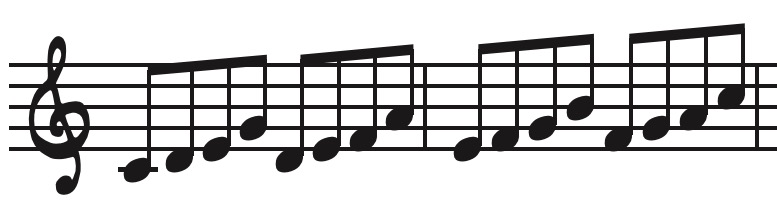
Sequence: A melodic idea that is repeated by starting on ascending (or descending) scale (or chord) tones. Essential for developing fluency with scales, but don’t overdo sequences during your solo. No one wants to hear you practice on the gig. 😉
Seventh chords: A melodic idea that is repeated by starting on ascending (or descending) scale (or chord) tones.
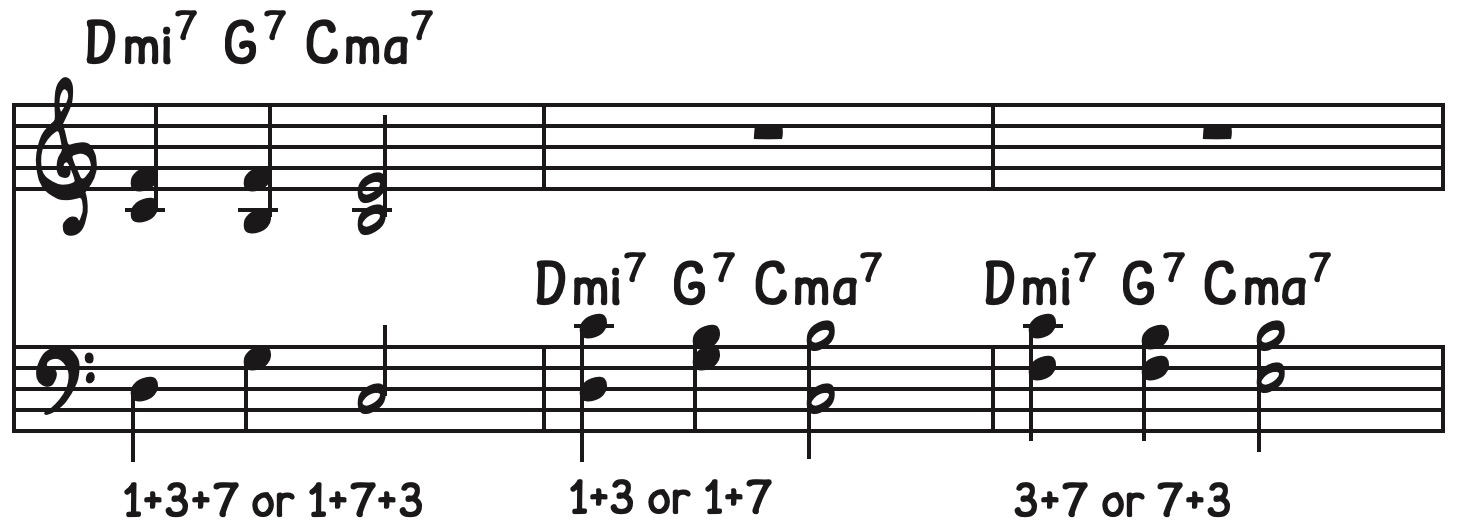
Shell voicings: There are 3 common interpretation of shell voicings. They are 1) voicings that include only the 1, 3, and 7 (or 1, 7, and 3); 2) voicings used by later swing and bebop pianists that use two notes, either 1 + 3 or 1 + 7; or 3) 2 note chords that use only the 3 + 7 or 7 + 3. [Note: it’s assumed that the 3 and/pr 7 might need to be lowered to create the right quality of the chord…minor, dominant etc.) Personally, I think of shell voicings as always including the 3 and 7, in any order. The root might be included (say, for Freddie Green style comping on guitar) or omitted (using the 3 and 7 as the lower notes of a voicing with extensions or alterations on top.)
Skip: A melodic interval of a 3rd (it “skips” over the adjoining scale tone.)
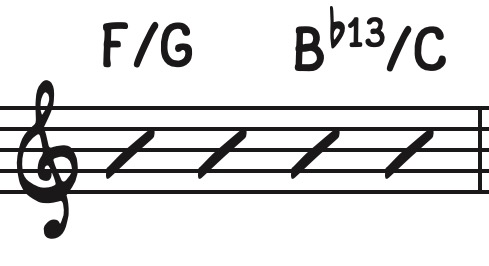
Slash chord: Chords symbols written as a “fraction” (Ex: Bb13/C.) It’s pronounced “Bb13 over C” or “Bb13 with a C in the bass.” I prefer the first way–much shorter. 🙂 They exist to indicate that a note other than the root of the chord is used as the bass note. [Note to composers and arrangers: please include the bottom part of the fraction (the bass note) in parts for rhythm section players. They need to know the bass note!] Pro: often makes for an easier chord symbol. Con: a little harder to figure out the chord/scale sometimes.
Spread voicing: Chord voicings using wider intervals (4th or higher.) Common in lower trombone and sak parts.
Step: In a scale, any two adjacent musical “letters” (Ex: D – E, or G – Ab.) Includes half- and whole steps (aka minor and major 2nds.)
Super locrian: Another name for the altered dominant scale. It’s the 7th mode of the jazz minor scale. (Hmmm…maybe it’s called super locrian because it’s the 7th mode, and it sounds so super?) To be honest, I can’t think of anyone in my circle that uses this term…altered dominant (or “altered, or even just “alt”) is much more common. You may be subject to taunting if you use the name super locrian. Don’t say I didn’t warn you. 😎
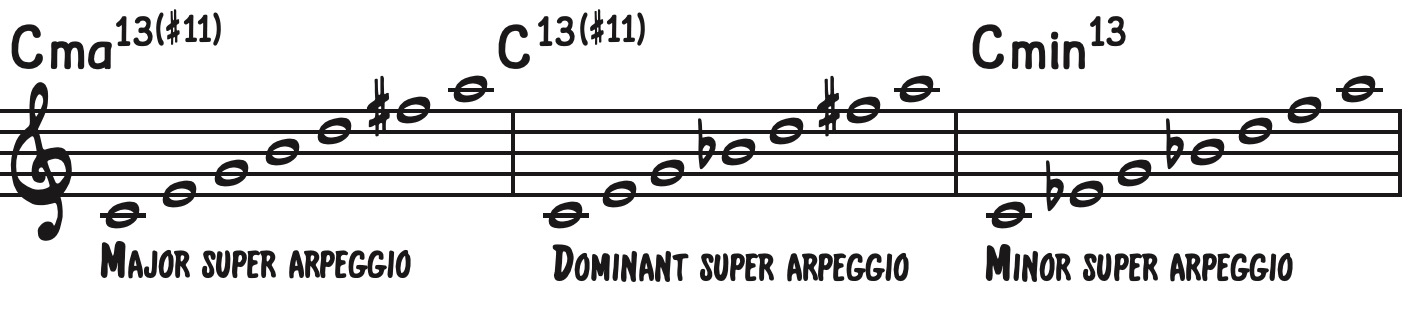
Super arpeggio: My own made-up term (I think) for an arpeggio that uses some form of 1 – 3 – 5 – 7 – 9 – 11 – 13; in other words, all 7 notes of the scale/mode, but stacked in 3rds. Most popular flavors are major, dominant, minor.
Suspended chord: Usually, a chord where the 4th replkaces the 3rd (Ex: Csus = C – F – G). In classical theory, the 4 usually resolves to the 3. In jazz this is not always the case.Sometimes you’ll see “sus2”, meaning it’s the 2 that replaces the 3.
Symmetrical scale: A scale built on a repeated pattern of intervals. Ex: whole tone, diminshed, and chromatic scales are symmetrical.
Tension (and release): How to keep the listener involved and engaged in a solo? The same way they do it in symphonies, novels, and horror films…tension and release. Like that slooooow climb at the start of a roller coaster ride (before the big drop!) Tension can be created with melody, harmony, rhythm, timbre…all sorts of ways. Just make sure you release that tension, or your listeners will wander off.
Tetrachord: Traditionally, a series of 4 notes, separated by 3 intervals (Ex: C D E F, or G A Bb C.) The most common tetrachords are W-W-H, W-H-W, H-W-W, or H-aug2-H (you need this last one for harmonic minor.) You can create almost every scale by combining 2 tetrachords.
Third inversion: Take a 2nd inversion chord (5 – 7 – 1 – 3) and move the bottom note up an octave (now, 7 – 1 – 3 – 5). Third inversions have the 7th on the bottom.
Tonal center: The tonal center is the tonic of the key that is resolved to…that feel like “home.” Play this: Cma7 Ami7 Dmi7 G7 CMa7. Doesn’t C feel like you’re now at rest? That’s the tonal center. If our solar system were chord changes the sun would be the tonal center. Not sure how solid my science is, but the imagery sure is beautiful. Know that, in jazz, tonal centers can change often. You really need to be on top of this to be a good improviser. Pro tip: make sure you know the ii – V progression in all 12 keys—it’s a great help in extablishing tonal centers.
Triad: A 3 note chord. Common triads include major, minor, diminished, and augmented.
Tritone: Literally, 3 “tones”: or whole steps (Ex: C – F#.) Other common terms are augented 4th or its enharmonic twin, the diminished 5th (Ex: C – Gb). This sound became an important bit of meldic vocalulary in the bebop era, and also inspired some interesting harminic ideas (see tritone substitutions.) It has a checkered past (Google Diaboilus in Musica) that Adam Neely describes really well here.
Short definition: For a dominant chord (say, G7.) you can substitute a different dominant chord rooted a tritone away (Db7.) This allows for chromaticism in the bass line (Ex: Dmi7 G7 CMa7 becomes Dmi7 Db7 CMa7.) The vital notes of the G7 chord (3rd = B, b7 = F) are the same notes in the tritone sub, but they have swapped roles (in Db, 3 = F, b7 = Cb/B.) For a more detailed discussion, see the Tritone Substitution link in the Jazz Theory 201 section.: Short definition: For a dominant chord (say, G7.) you can substitute a different dominant chord rooted a tritone away (Db7.) This allows for chromaticism in the bass line (Ex: Dmi7 G7 CMa7 becomes Dmi7 Db7 CMa7.) The vital notes of the G7 chord (3rd = B, b7 = F) are the same notes in the tritone sub, but they have swapped roles (in Db, 3 = F, b7 = Cb/B.) For a more detailed discussion, see the Tritone Substitution link in the Jazz Theory 201 section.
Turnaround: A short (often 2 measure) chord progression at the end of a phrase or chorus. You can find more detailed info on turnarounds in the Jazz Theory 201 section. Fun fact: there’s also a cool blues tune by Ornette Coleman called The Turnaround. It contains, to no one’s surprise, a pretty unique turnaround.
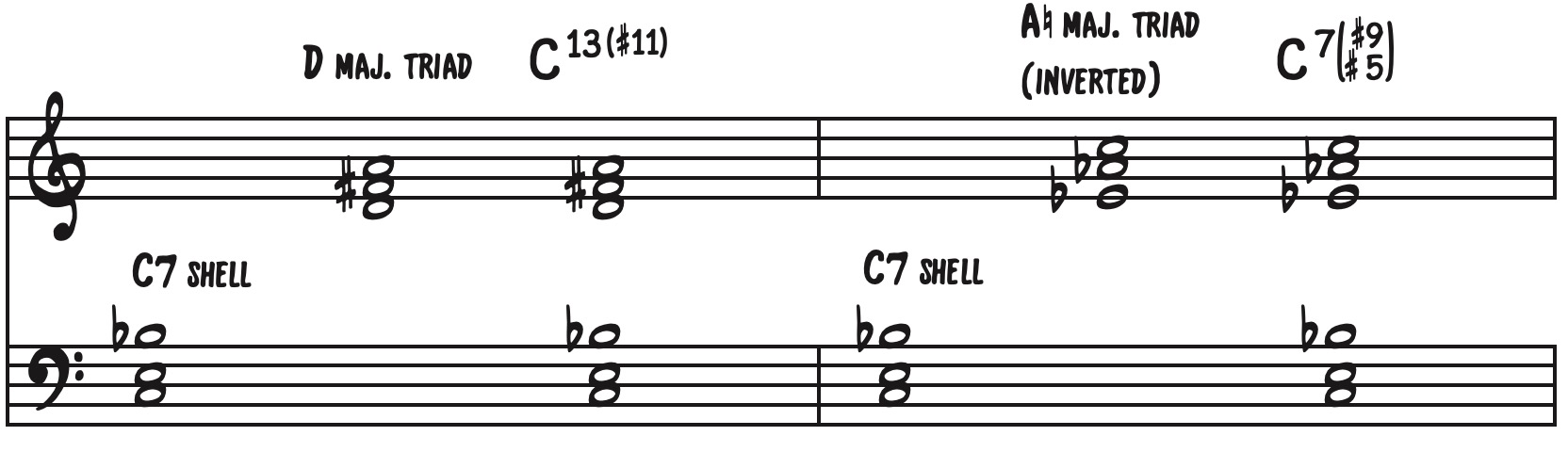
Upper structure triad: Often, the extensions or alterations of a chord spell a brand new triad. Ex: C13(#11) can be seen as a D major triad “on top of” the C7 chord. Or, C7(#5#9) can be seen as an Ab major triad on top of the C7. This is super useful info for comping instruments and arranger composers, of course. And for soloists…try using the upper stucture triads as melodic material over the approp[riate chord. Sweet! Learn more in Jazz Theory 301.
Voicing: Verb: the creative act of deciding how to arrange the notes within a chord. How many notes? How are they spaced, and in what order. Register? What to omit? What note to put on top? Noun: the result of voicing is called…voicing. It’s what the performer plays (or what the composer writes) for the chord. When chord symbols are used, it’s up to the performer to create good-sounding voicings for those chords.
Whole step: Same as a Ma2 interval; or, two half steps.
Whole tone scale: A 6 note scale (then the octave) made up entirely of whole tones. It was widely used by Debussy and other Impressionist composers; you’ll hear a lot of whole tone lines in Monk’s playing as well. If you take the notes in a whole tone scale (Ex: C D E F# G# Bb C) and look for a related chord, it would be a C9 (b5#5) or some other enharmonic equivalent. Fun fact: there are only 2 possible wholoe tone scales…each one has 6 notes…2 X 6 + 12. Math is fun! 🧮
Whole-half diminished scale: A more detailed name for the diminished scale. It is sometimes used to avoid confusion with the half-whole diminished (AKA the dominant 9 tone) scale.