This chart is unusual in that it works great for bands from middle school up through university level (up the tempo, let the soloists roam free!) It’s a modal tune over an ostinato, with enough melodic twists to keeps everyone engaged. Here are some things I find myself saying a lot when I’m working with a band on Abyssinia.
You can download a PDF of this Inside the Score here.
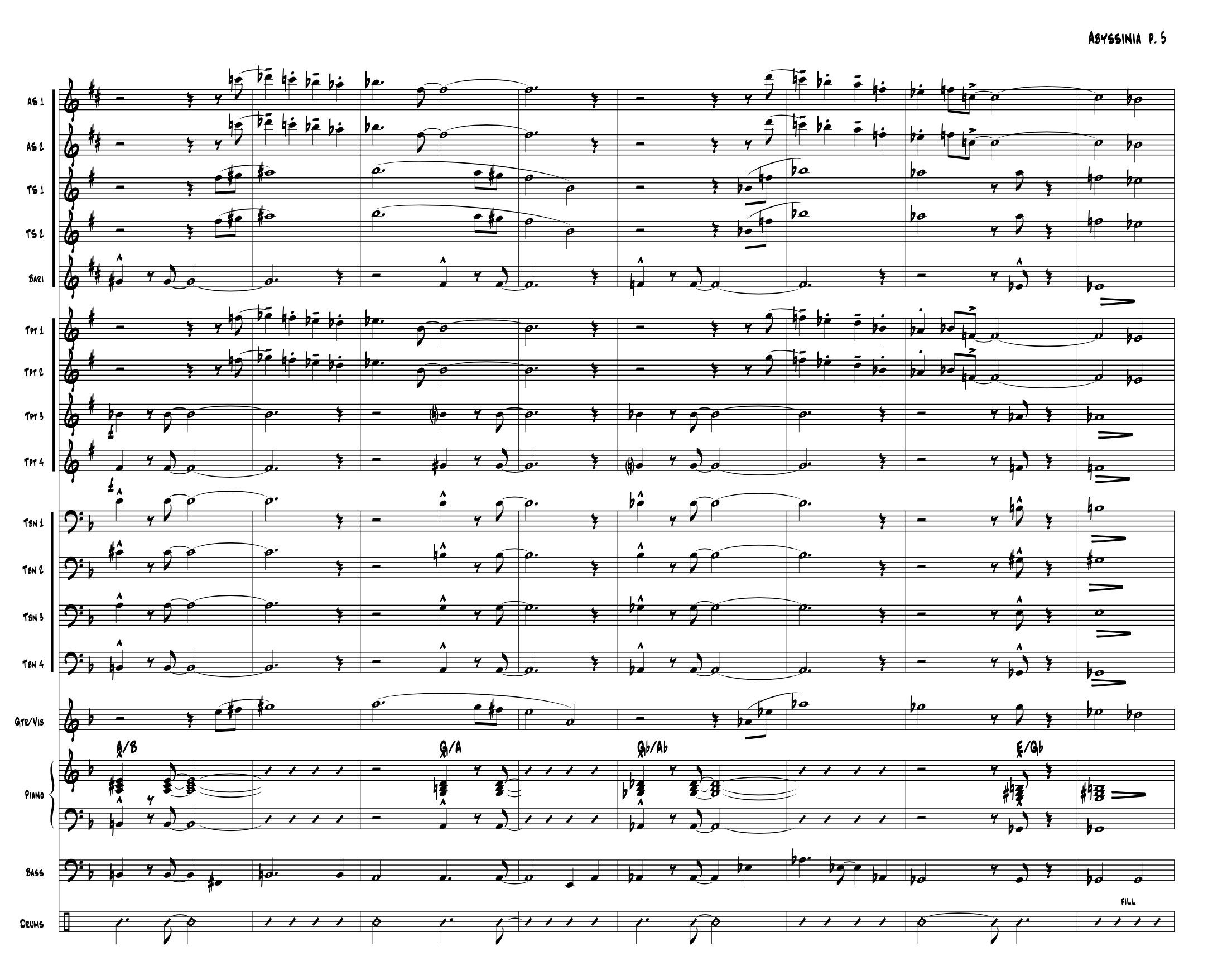
Phrasing: It goes without saying (but I’ll say it anyway) that articulations are important. Have the players exaggerate these at first (for younger groups) to make sure they “get it.” Melody players, accent the eighth notes on beats 1 and 3, 6 after A, and add a crescendo 3 after B on the half note. All–don’t be shy on the crescendo bar before B (I loves me some bass bone there, and 8 after B too!) C is 8 bars of “settling down” heading into the solo section.
Rhythmic “gotchas”: nothing super tricky, but it is important that the countermelody “mesh” with the melody at A & B 2ndtime. Rehearse it slowly so students can hear how things fir. Articulations really help the clarity.
Balance: make sure the tenor/guitar countermelody comes out at A & B, and add a crescendo on the whole note 7 before C. Bones 1 & 2 can lean into the dissonance 4thbar of B. Altos, tenors, guitar, your line 2 before the DC is super important; it defines the end of the solo section AND sets up the return to the top. Be strong!
Solo section: this is a 32 bar AABA form. The A sections are an F7(sus) chord (the 3rdA is slightly different) and the B section (1st8 bars of E) are GbMa7/Ab, which is kind of a very hip version of Ab7(sus). So, make sure the soloists know mixolydian scales on F and Ab concert, and you’re off to a good start. Of course, there are some cooler ways to approach this. I’ve included these on a PDF you can download here.
Multiple soloists: I’d get tired of hearing the ostinato at D and E after a while, so if you’re going to feature several soloists, consider alternating the ostinato thing with some straight-ahead swing section. I’ve made a short PDF with some suggestions that you can download here. You can keep taking the 1stending, taking the 2ndon the very last time. Or, each soloist can play 2 choruses, take 1st then 2ndendings, going back to D (you’d continue on after the last solo.) And, if you have a burnin’ soloist, try a chorus of, say, tenor and drums as a duo (drums, you gotta burn too!) When the rest of the rhythm section comes back in for the 2ndchorus, it’ll be amazing!
Rhythm section: the drum feel is very busy, active time…have your drummer check out Elvin Jones if they haven’t already. The kicks at D should only be played if the ensemble is also playing them (see Solo Section above.) Always help define the form with fills at the end of 8 bar phrases. It’s super important that the rhythm section define the new “key” of the bridge (letter E.) Be really solid here. Vibes, play the written lines an octave lower.
Coda: Brass, -1 second bar of F. Saxes, strong accent on 1 and 4 5 after, and on 3 6 after. ALL: don’t rush 9 after! Saxes, be strong on 4+ seven from the end. ALL: 3 beats of silence, next to last bar. Altos and tenors, it’s just you on the last note. Soft, but supported.
I hope this “Inside the Score” gave you some things to work on at your next rehearsals. Please let me know if you have any other questions. And, if there’s a cool video of your group’s performance, send me the link!
–Mike