This chart was commissioned by Kirk Clague for the Exeter High School Jazz Ensemble. He wanted a chart that would challenge the band rhythmically, that was very contemporary, featured the drums a bit, and that had reasonable brass ranges. Another request: keep the solo section easy, allow for multiple soloists, and have a little “something extra” for his strong soloist. Sound familiar? 🙂 This chart worked out great! If you need a hard copy of this Inside The Score, you can download the PDF here.
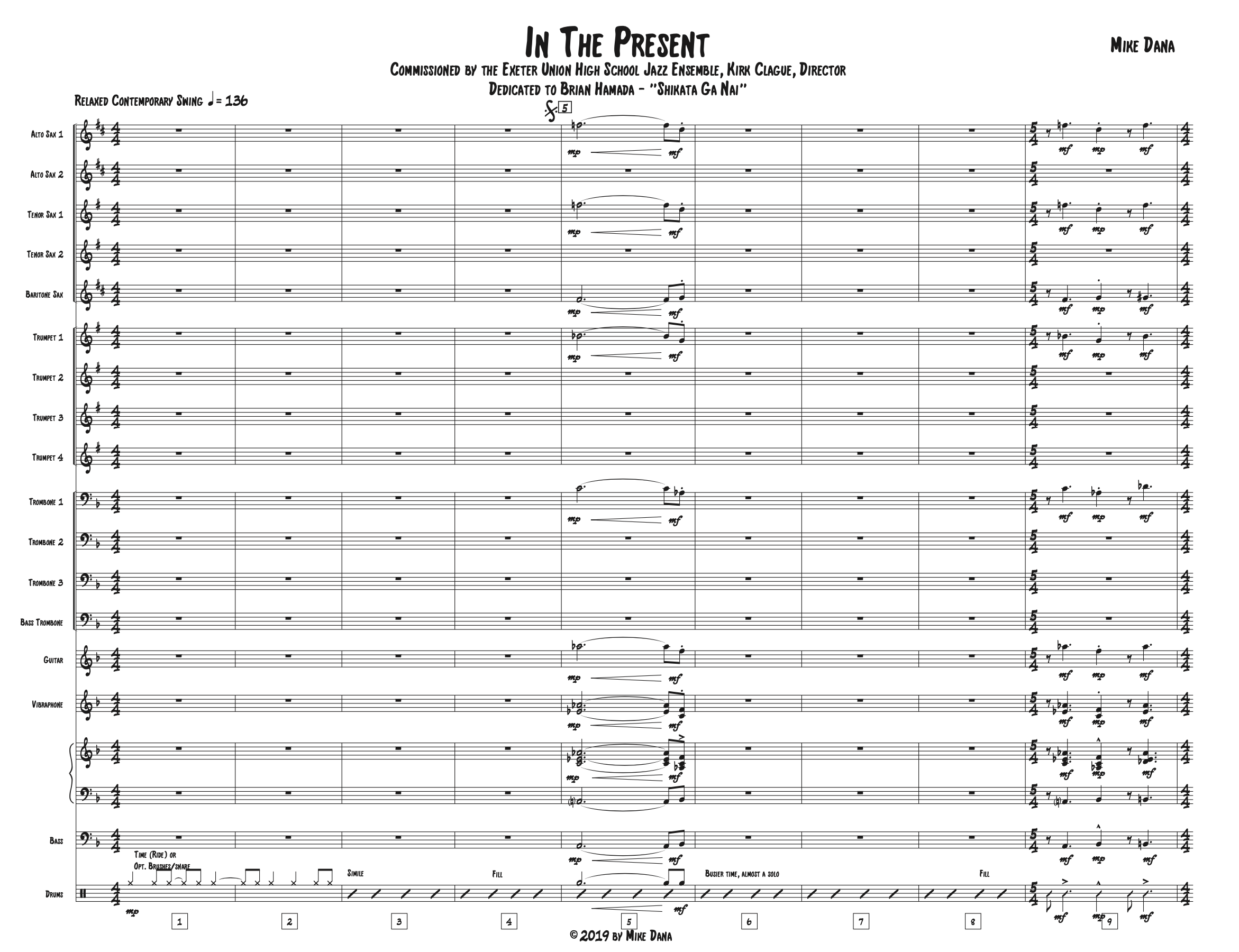
Rhythmic “gotchas”: My idea was to have the chart start with 4 bars of time on the drums, then have the horns enter as you’d expect, then hit you with the changing meters and asymmetrical phrasing…”Wait a sec…where the heck is one?” This playing around with familiar (-ish) sounding ideas in unfamiliar settings is the DNA of the chart.
Balance: In general, the dynamic markings are super important. Thesenuances are part of the identity of each phrase I’d also reinforce the concept of fore-, mid-, and background (see mm. 17 – 31.) These shift quickly, and the players need to think about ensemble sound and not just their own part. Make sure that the trumpet “sounds” as the lead voice in the small group sections.
Solo section: The main solo section (16 bars, starting at m. 42) is designed to be “beginner friendly.” Only 2 Dorian scales, D and Bb, are used. But—gotta be Dorian! I teach this as a major scale with a lowered 3 and 7 [just like the minor chords they go with!] and not as “for D Dorian, play a C scale.” There are solo sheets included for all keys that have the scales and some melodic “starters.” No written solos…I really think that students should start improvising early on, and in a setting where they can be successful (like here.) But wait—there’s more! 🙂 Download the addition solo info sheets here.
Multiple soloists: If you decide to open it up, I’d suggest that each soloist play twice through at 42; no backgrounds the first time, backgrounds in on the second (you could consider the whole note at m. 42 as “belonging to” the previous background phrase, and play it after the bkgs…or not. Works either way.) And, if you’re going to open it WAY up (more than 3 soloists) I think it’d be great to change up the rhythm section feel in the middle. If this feels scary, I have some ideas you can try…download those here. Last thing: since the backgrounds are mostly 2 parts (altos + trumpets, tenors + trombones) you can mix’n’match them. Try altos + bones for a trumpet solo, or trumpets + tenors for an alto solo.
Rhythm section: Unless your band is full of above-average sight readers, I’d advise that you get the rhythm section solid first, then read the chart down with the band. The drummer needs to make every wind entrance feel natural (even when it’s not,) and should play appropriate fills that set up each entrance. BTW, originally I had the drummer using sticks throughout, but when I heard this drummer start with brushes and switch to sticks later, I dug it (and changed the part!) Guitar & vibes, when you have melodic lines, you’re doubling winds, so match their phrasing!
I hope this “Inside the Score” gave you some things to work on at your next rehearsals. Please let me know if you have any other questions. And, if there’s a cool video of your group’s performance, send me the link!
–Mike